
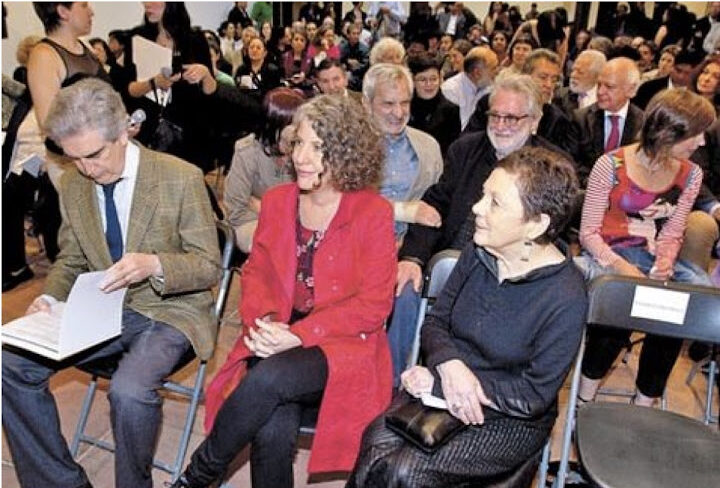
Rafael Tovar y de Teresa and Itala Schmelz during the event. (Omar Meneses)
Centro de la Imagen
A Brief History of the FotoMuseo Cuatro Caminos
The year was 2011. We were ushered into the office of Consuelo Sáizar, the director of the National Council for Culture and the Arts, better known as Conaculta, which would eventually be transformed into another secretariat of the Mexican state. If all this sounds like a lot of bureaucracy, it is because it is. If there is one thing that personally causes me a bout of discomfort, it is having to deal with bureaucracies, whether from Mexico or anywhere else in the world. I understand them and assume that it is inevitable to have bureaucratic apparatuses; this is the way to organize society from the government or the power or whatever you want to call it. Bureaucracies have existed since human beings decided to increase the number of people who organized themselves to grow beyond a small tribe.
But well, the reader will say, what does bureaucracy have to do with this story? Well, it turns out that it is the central axis of my story; I only ask for a little patience to get to that part.
As a photographer who has participated from the beginning—from the seventies—in trade organizations to ensure that our activity in Mexico gains citizenship, in the midst of an environment resistant to photographic art, the scope and limitations of these structures have become clear to me, and in an act of realism, I also assume that it is not possible to operate outside of bureaucracy.
So in 1976 we founded the Mexican Council of Photography, which with a very reduced state budget, and acting as a collegiate body, received those funds to operate. For me, that was the beginning of the modern history of contemporary photography in our country.
We did well; very important achievements were made, such as the successive Latin American Colloquiums of Photography, the Biennial of Photography in Mexico and the House of Photography in Mexico City, in which there were one hundred exhibitions. The first efforts were initiated to decentralize the incipient trade union activities, until then mostly concentrated in the metropolis. The first photography workshops were taught in the Mexican Republic. In short, it can be said that our focus was on seeing and developing the photographic image more for its artistic, aesthetic, historical and cultural value than for its commercial significance, with the understanding that the art market, and the editorial market, are also commercial, of course.
The Mexican Council of Photography (we had to give it some name, right?) was just a handful of colleagues who shared the same interest in improving the status of photography. Its creation stemmed from the need for an organization to convene photographers to the first Colloquium and receive their works. Finally, we managed to get the state to see the political convenience of not distancing itself too much from photographic activities simply because it did not fully understand them.
So when Conaculta was founded, the state took action on the matter. Víctor Flores Olea, its first head – who was in turn an avid and sophisticated photographer – invited me to participate with him to coordinate Mexican photography. I suppose that my years at the head of the Mexican Council of Photography were the main reason for extending such a valuable invitation to me.
At that time I was in Los Angeles, California, immersed in two tasks that were fundamental to me: the first, the development of that first CDROM with image and sound, in which I was narrating the last three years of my parents’ lives, and the second, the fulfillment of the objectives indicated to comply with the Guggenheim Fellowship that had been honorably granted to me. Both projects prevented me from returning to Mexico City to perform in the trade union task.
However, in order not to underestimate that show of confidence on the part of lic. Flores Olea, I offered to carry out, without any payment, a work plan that could serve as a guide for activities related to photography in Mexico, in terms of what would later be the Centro de la Imagen. Note the use of the word image instead of photography to evidence the transition to the digital age. Fortunately, my proposal was adopted, because I think it contributed to framing the beginning of that new era in our country.
Never before had so much budget been allocated to photographic activity. And as we all know, along with resources come important developments, but also complications. From a spirit of inter-union cooperation, it very soon moved to one of unrestrained competition for the allocation of resources. It seems that this is the history of all humanity, when money appears.
The Centro de la Imagen lived its best years under the direction of Patricia Mendoza, who in addition to being an art historian, had trade union experience, which she had expanded with us at the Mexican Council of Photography, since she was in charge of coordinating our Second Latin American Colloquium; she had dealings with all the creators and had a vast visual culture.
But of course, the Centro de la Imagen was not exempt nor was it alien to the comings and goings of the governmental policy in turn, and as things were, in a second stage its operating budgets were substantially reduced. Alejandro Castellanos, its new director, had the unenviable task of dealing with that budget reduction. Much of the collective anger over the reductions fell undeservedly, I believe, on the head of Dr. Castellanos. The authorities abused his proverbial bonhomie and hid behind him to shrink the economic support for photographic activity.
Some years passed and it seemed to me that we had to try a new and different strategy regarding financing the photography project in Mexico. Depending only on the state was not an option that offered much security to the union, given that we were fully entering the digital age; the opportunities and needs were already different, and more complex every day.
The state, paternalistic as it usually is, only watched over its own electoral interests, or personal ones in its case; rarely is there a strategy designed for the benefit of the community. But they are the ones who have all the money—which is ours, after all—and with it they have the power to orient all activity to their liking and pleasure.
Armed with that conviction, I again presented a new strategy in a project directed to Conaculta. And that is where this new story begins, that of the FotoMuseo Cuatro Caminos.
My reflections were very simple:
- We had already explored a totally union organization (the Mexican Council of Photography).
- We have already explored an organization, the Centro de la Imagen, totally dependent on Conaculta.
- Why not explore now a hybrid, half civil society and half state?
The combination of the state with civil society made a lot of sense to me, because of the slow and inefficient way in which the bureaucracy operates, because in the world of new technologies its times do not run well. I will give an example: by the time the purchase order for a piece of equipment or the update of a program comes out, the equipment or the program itself is usually in the next update. That is just to mention a very basic example. The bureaucracy decides based on pleasing someone, who is usually higher up on the hierarchical ladder; those of us who are in the daily trenches of creative work are not the beneficiaries nor are we taken into account.
That led me to suggest that, in this new stage of the Centro de la Imagen, energies should be focused mainly on everything related to the conservation of the works and the history of Mexican photographic artists, as well as on their dissemination. In this way we, at the Foto Museo, could dedicate ourselves to the future of the image, to technological development and visual explorations, alien to the norms and times of the bureaucracy.
The idea was that the Centro de la Imagen would be dedicated to the custody of what already exists, and that the FotoMuseo would be in charge of exploration towards the future, given that we were not, by far, the only alternative in that looking forward. The notion of today moves along with the calendar, and for obvious reasons both today and yesterday are equally important. Everything of today becomes the tomorrow of history the next day. The budget and facilities of the Centro de la Imagen were guided to reinforce its role of custody, something that we expressly refused to do from the FotoMuseo, where I refused to have a permanent collection: all the resources had to be directed to the present and the future.
Even though I directly had nothing to do with the Consejo Mexicano de Fotografía, I was able to exercise my authority, with that right that the years lived give you and also for being the original promoter of what became the main collection of Latin American photography in the world. Armed with that impulse, I organized, together with Alejandro Castellanos, the legal donation to the Centro de la Imagen of the collection that was still assigned to the Council. There was not the slightest desire on my part to appropriate that valuable collection for the FotoMuseo Cuatro Caminos. It seemed to me that the Centro de la Imagen, with its professional researchers in the various areas of photographic work, would be much better equipped for that necessary work of custody.
In passing, we cleaned up all the legal issues, reports and taxes that for years the comrades had left unattended before the Treasury of the State, a task that took a long time to resolve, but that in the end was overcome thanks to the dedication of some officials of Conaculta itself. They did not even realize the singular irony of how one bureaucracy was there to feed the other. As long as everyone was satisfied, the objectives would have been achieved.
I return now to the beginning of this story. We went to see Consuelo Sáizar, as I had already said, to propose that she sponsor a part of the operating cost of the FotoMuseo, because I thought that could be her contribution to the trade union development, thus uniting the forces of civil society (us) with those of them (the state). We would contribute the know-how as it is usually said, and they would give us back a part of our money (taxes) to be able to operate. We would thus join hunger with the desire to eat. I gave the official numerous examples of how the economies of the future would be related to knowledge in a more pronounced way every day. That everything related to photography/image would be on that border of knowledge. That Instagram—a portal recently acquired then by Facebook, created by a dozen young creative entrepreneurs—had been bought for more money than was sold in photos worldwide during the first one hundred and fifty years of photography’s existence.
Consuelo Sáizar thought that the proposal of the FotoMuseo Cuatro Camino was very appropriate, and congratulated us for having brought her such an interesting project. She immediately said yes, and encouraged me to walk fast with my part of the commitment, that of adapting the venue, which was also going to be one of the largest in the world: around five thousand square meters dedicated only to photography.
I invited Mauricio Rocha to the project, who was almost like a son of mine, since he shared most of his adolescence with me debating between being a soccer player or an architect. As his interest in architecture won, and he also did it very well and with great success, it seemed to me that it would be a very nice adventure to work with him. Thus, we dedicated ourselves for more than a year to meeting week after week, to decide step by step what would be the best options.
The task began of remodeling a building that was already very old and run down, which had originally been built for a plastics factory owned by my father, with the nice detail that it was my first job after leaving the University and that my father, in turn, had undertaken that industrial adventure just a few months before. In other words, around this building we were all, in our corresponding moment, innovators. Remember that the plastics business at that time was not so different from everything that surrounds the digital age today.
My father never tired of recounting how he was inspired by Dustin Hoffman’s phrase in The Graduate, when Dustin says prophetically: The Future is in plastics.
My parents inherited that building to me, and also a modest amount of money, which in the end went entirely to the rescue of the ignominious end that could await that property: that the State would keep it, and all for not having the deeds that demonstrated my legitimate ownership. As things were, I delayed 18 years with three lawyers so that I could finally have legal access to the building. All those years went by without giving maintenance to the property that, legally, was not mine; I could not do it until I had the papers that proved that I was the owner. For that reason, and in order to celebrate the return to its legitimate owner, it seemed to me that dedicating that building to something as important as a museum would be a well-reasoned mission and a worthy tribute to my parents.
But I have already deviated. I return to the story of how the adventure of starting the FotoMuseo Cuatro Caminos began.
Everything was going very well when a accountant from the office of the director of Conaculta called us to tell us that we could go to receive our first contribution for the start-up of the FotoMuseo.
We had already filled out more than 500 pages of documents that accredited absolutely everything that was planned to be done, with what, with whom, at what time, how much and why.
For me, the great mystery is how they manage to steal so much, when there are so many locks that the bureaucracy imposes on any movement of money in their dealings with them. But that is not what it is about now; let me tell you that an hour after that call, they call us again to tell us that they will not be able to give us the resources, because “they had run out of money”. And all that in the space of an hour? One can only smile at such nonsense.
And as bureaucracies are very creative when it comes to finding justifications for everything, a few hours later they tell us that apart from the story of the money they no longer had, they were missing documents that we supposedly had not delivered to them. They did have them, only the left arm of that bureaucracy had not delivered it to the right side of it.
The result of that bad start was that we stopped the work of the FotoMuseo already in process. And so we let the authorities know. They urgently summoned us to new meetings. The first of them was in the middle of the pharaonic works that were being carried out at that moment in the Biblioteca México, next to the Centro de la Imagen, which was also being remodeled. For this they raised the entire esplanade of the entrance, which was covered with colonial stones. That work, ordered by Consuelo Sáizar and not by the architect in charge of the remodeling of the Centro de la Imagen, made him resign in protest for the vandalistic act of lifting all those stones, ordered no less by the director of Conaculta.
In the end they put all the stones back in their place. They spent millions to carry out that totally useless maneuver, while they could not give us what was committed to continue with a work where every penny was taken care of.
In total, Calderon’s six-year term concluded, they never gave us the money committed, Consuelo Sáizar was a disaster, she left us deceived in a half-finished project and left debts from her administration for more than five hundred million pesos, which was the first thing that the incoming government had to cover. The new director of Conaculta, and who would become the first Secretary of Culture, Rafael Tovar y de Teresa, was honest with us and explained how everything was. Little by little, to the extent of the budgets he had, and as he was able, he sent us resources so that the idea of the FotoMuseo could survive.
Unfortunately, Rafael Tovar y de Teresa, a cultured official with an honest vision about photography and new technologies, and who was a good interlocutor, passed away at an early age. And with that, the FotoMuseo project once again fell into a period where the fragility of being exposed to six-year and political vicissitudes became evident once more. This does not contribute to the functioning of the relationship between the state and civil society, which seemed to be the solution.
We can all see at a glance how officials are subjected, in turn, to a world of thousands of pressures, including some that are alien to their own operational visions.
I could not finish without telling the anecdote of when we processed the permit for land use in the State of Mexico, the entity in which the FotoMuseo property is located. The official on duty asks us, with a long list of options noted in her folder, what the property was going to be used for. A museum, I replied. She reviewed her list again and again. She looked up and, from behind her glasses, said to me: it is not possible, we do not have that possibility, there are no museums here. Exactly! I said to her, here we have a surrounding population almost as large as a Central American country, and we do not have a single museum. Finally, what we agreed was that the land use would be for a house of culture. That bureaucratic solution seemed very reasonable to me and gave rise to further reflection on the relevance of the name FotoMuseo.
Unfortunately, to all this is added the social instability that surrounds us, and how it is revealed—a term that comes from photography—in violence, theft, assaults, murders, even organized crime trying to collect what they call land use (we told them that on the contrary: they should give us contributions, not us to them). The truth is that all this makes the cultural task that we should be doing practically impossible.
Let us think, on the one hand, about the urban layout. There were no considerations for the existence of a museum, and on the other, organized crime was trying to extort us for having set one up. Every time we inaugurated an exhibition at the FotoMuseo, and we expected to receive a few thousand visitors, there was a long list of corrupt officials, from police onwards, waiting to receive their corresponding fees for giving support and not preventing the event. All that only increased the costs. We were an organization that everyone was looking for how to milk, but not contribute anything to, and that made the project unfeasible.
We thought about it carefully and assumed that it was impractical to continue fighting against all the headwinds. You also have to know when to give up. That did not make our drive to contribute something of value to society disappear.
Hence the idea was now born to invest our dwindling resources and energy in the creation of this collection of books, from whose reading, we suppose, something will remain that may be of interest to society. We maintain the romantic idea that it is only with education that this country will be able to prosper.
And to finish, I will tell you that the name FotoMuseo comes from my questioning of how singular it was to be a space like the one we made, when the terms used in its definition were in question. What is photography today? What is a museum today? Both definitions are in a period of transition, and only time will give us the answer.
And the matter of the Four Paths is because, right where the building of what was the FotoMuseo is located, there was the confluence of the four main paths that gave access in pre-Hispanic times to what was Tenochtitlan. What a fortunate way to represent that intersection of paths that occurs today, between technologies, the arts, the economy and health.
Pedro Meyer
November 9, 2021, second year of the pandemic
[1] Meyer, P. (1990, December 24). [Letter to Victor Flores Olea]. Archivo Fundación Pedro Meyer.