
Chromatic Impressions of Chapultepec”
(Mexico City, 1963-1964)
Two magical moments in the beginnings of photography.
I was a young man interested in photography from the age of eleven, when my parents gave me a magic box, a Kodak Brownie camera, which I still have today, at 88 years old.
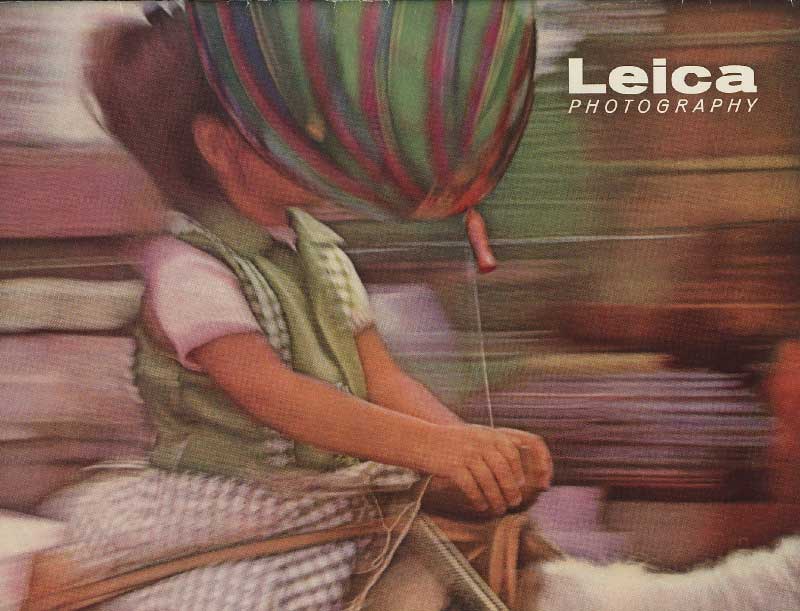
The second magical moment—and also a camera—came into my hands at the age of 29, when Leica granted me the extravagant luxury of owning one of the first LEICAFLEX cameras they launched that year (1964). Their generosity was given in exchange for me presenting my audiovisual about the Chapultepec Forest in New York for a week.
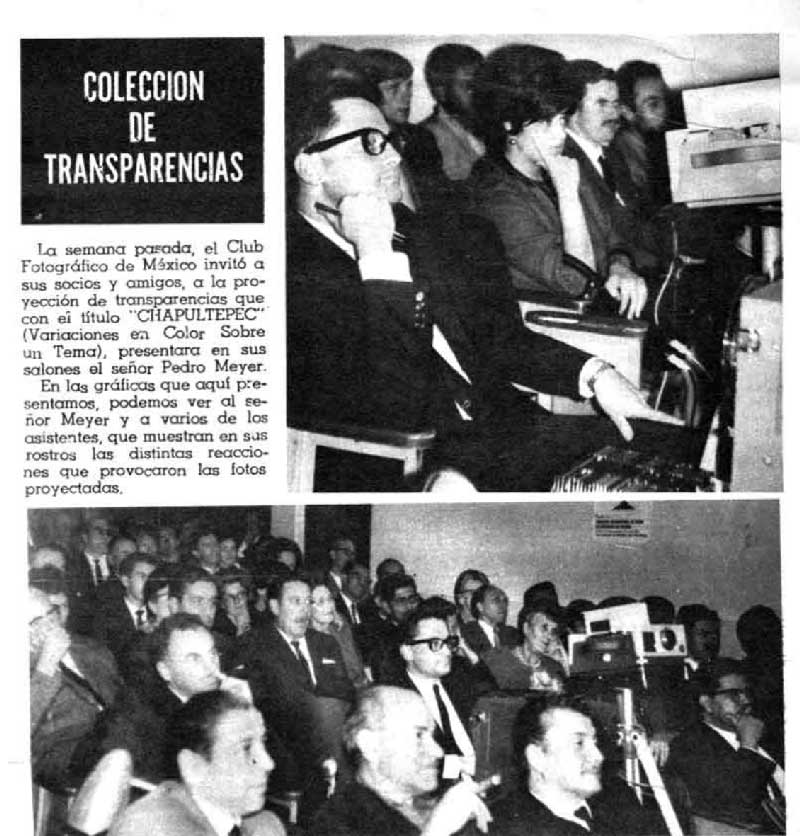
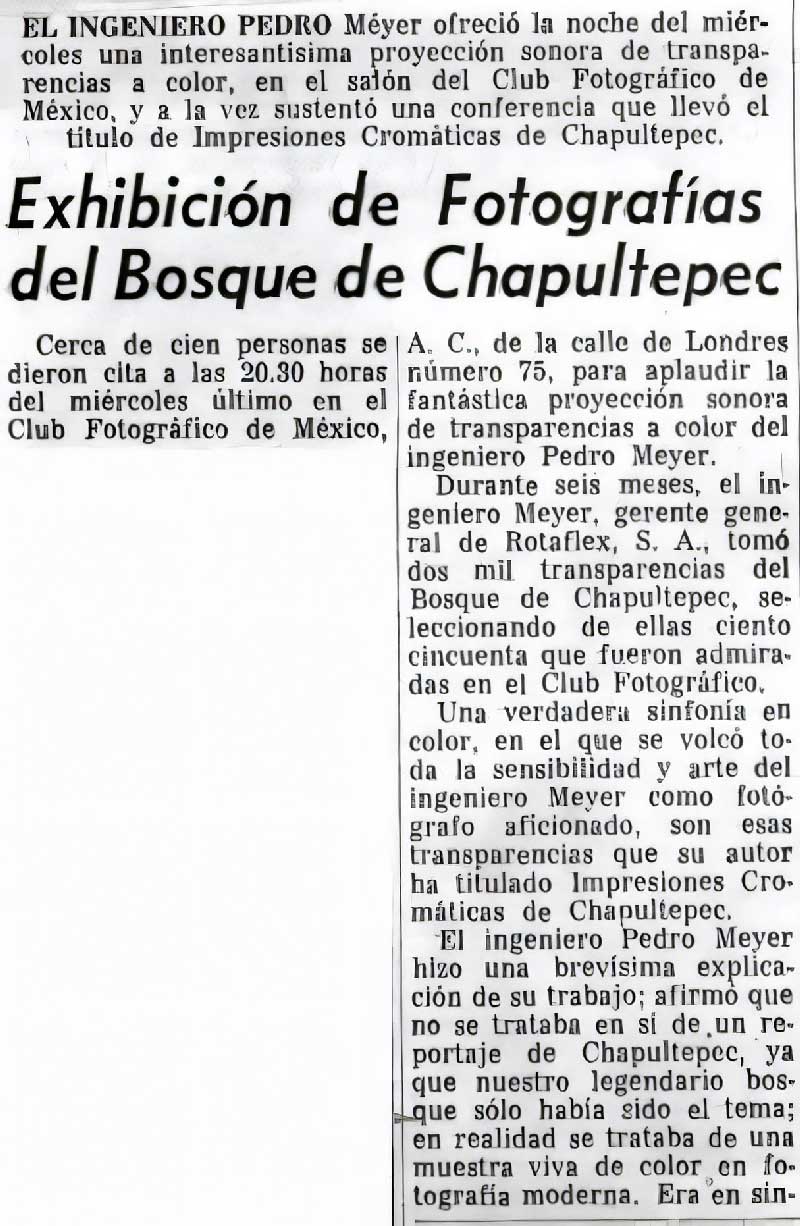
That work was the first audiovisual made in Mexico, created by me at the mature age of 28. It was an exploration of images and sounds in the Chapultepec Forest of Mexico City. Can one measure what such an impulse meant in what would later become a long journey towards my photographic career? Let’s just say that the attention my images received was incredible, but becoming the proud owner of such a unique camera was, in itself, quite a journey.
I don’t know where or how I came up with the idea of creating what would be the first audiovisual made in Mexico. I made it by photographing the Chapultepec Forest—the main one in Mexico City—every weekend for a year. I spent hours there taking 35 mm color slide photographs with Agfa film. As the Agfa laboratory was close to my house, it was a good combination: every week I delivered my rolls to be developed. I still remember nervously waiting to discover what I had captured: whether it turned out as I had imagined or, as often happened, left me unsatisfied.
I did this body of work while I was part of the CFM (Photographic Club of Mexico), which at that time had about 80 members. It was my first opportunity to explore photography beyond my solitary and isolated work. It must be remembered that at that time there were no publications or workshops available for someone like me. I wanted to learn more about the medium, but there was no way. My mentor, so to speak, was the person in charge of cleaning the darkroom, who passed me the chemical formulas. In a competitive environment, with so many monthly contests, it was not common to share secrets with colleagues who could become rivals.
I remained in the Photographic Club for about four or five years. I won a good number of prizes and medals, which I still keep in some corner of my archive. At first it was stimulating, because it was a way to receive a reward for the effort of taking photographs. But that was it: there was absolutely no artistic debate of any kind.
After taking the images, I had to face the complicated part: editing the photographic material and adding a soundtrack. This involved creating an audio track with my vinyl records at home, a task I accomplished with my open reel recorder and scissors (don’t laugh!). I remember it was a SONY recorder. The challenge then was to synchronize the slide projector with the sound. I solved it by building a solenoid, a metal rod that acted as a circuit breaker.
That small tube, cut in two and separated at its top and bottom, allowed that, when the tape crossed, the metallic surface closed the solenoid circuit and this activated the projector, matching the projection with a new slide. The metallic marks on the tape were achieved by sticking strips of aluminum foil taken from cigarette packs, cut to the width of the tape and placed exactly at the point where the image should change.
To achieve a transition from one image to another, we installed two parallel projectors and placed between them a propeller mounted on an axis, which was activated by hand and covered the lens of one projector while uncovering the other. You had to be very careful not to confuse the narrative sequence.
Assembling all this equipment—the two slide projectors, the recorder, the amplifier, the speakers, the cables—was a long and cumbersome process. Imagine my amazement 35 years later, when the digital age offered us the possibility of reducing all that to a single CD-ROM that could circulate throughout the world.
And that was precisely what I did with the publication of what would become the first CD-ROM with sound and images from beginning to end. That seminal work became known as “I Photograph to Remember” (Fotografío para recordar).
Pedro Meyer May 2, 2023